Launching an AI feature often starts with a deceptively simple question:
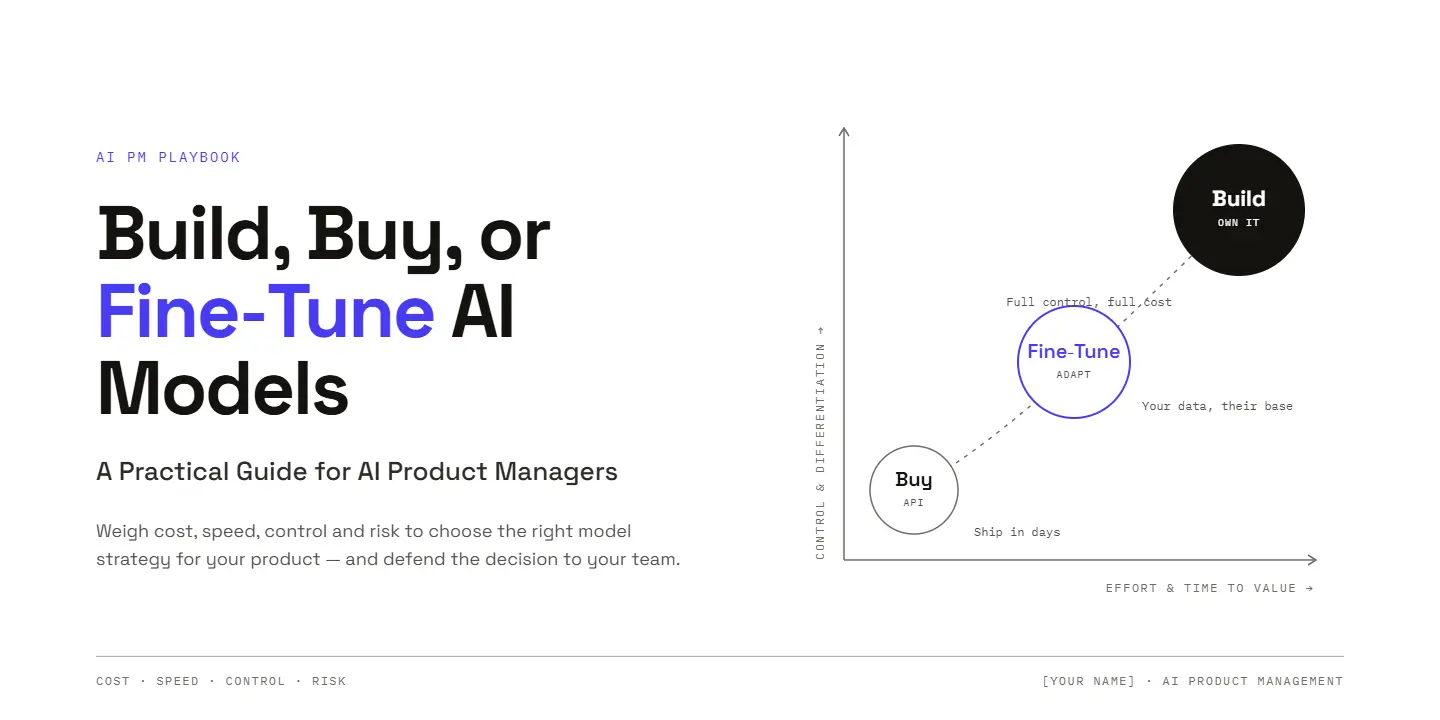
Should we build the model, buy access to one, or fine-tune an existing model?
The answer can determine whether your product ships in weeks or takes years—and whether the project costs thousands or millions of dollars.
For AI Product Managers, this is not just a technical decision. It is a product, cost, speed, risk, and scalability decision.
The good news is that you rarely need to build an AI model from scratch. In most cases, the smartest approach is to start with the simplest solution and increase complexity only when the evidence justifies it.
Build vs Buy vs Fine-Tune: The Big Picture
Think of an AI model like a place to live.
- Using an AI API is like renting an apartment. You can move in quickly, and the landlord handles maintenance, but your control is limited.
- Pre-training a model from scratch is like building a house. You control everything, but the investment in land, construction, infrastructure, and maintenance is enormous.
- Fine-tuning a model is like renovating an existing house. You retain the underlying structure but customize it for a specific purpose.
- Prompting and Retrieval-Augmented Generation (RAG) are closer to renting a furnished apartment. You can provide instructions, context, and information without changing the underlying structure.
This framework helps AI Product Managers think about the trade-offs before committing engineering resources.
Option 1: Buy — Start With an AI API
For most new AI features, using an existing model through an API should be the starting point.
You get access to a capable foundation model without having to train, host, and maintain the underlying infrastructure yourself.
Advantages
- Fastest time to market
- Lower upfront investment
- No model-training infrastructure
- Vendor handles model improvements
- Easier experimentation
- Scales with product demand
The main trade-off is control. You depend on the model provider’s capabilities, pricing, availability, and product roadmap.
For an early-stage feature, however, speed and learning are often more valuable than maximum control.
Example
Suppose you want to build an AI assistant that summarizes customer feedback.
Before fine-tuning or training anything, you can:
- Choose a capable foundation model.
- Design a strong system prompt.
- Provide representative examples.
- Test the output against a quality benchmark.
- Launch an MVP.
- Measure whether users actually find the feature valuable.
If the API-based solution performs well, there may be no reason to increase complexity.
Option 2: Fine-Tune — Renovate an Existing Model
Fine-tuning makes sense when a foundation model is capable of performing your task but consistently produces the wrong style, structure, behavior, or format.
You take an existing model and train it further using examples that represent the behavior you want.
When Fine-Tuning Can Help
Fine-tuning can be useful when you need:
- A consistent output format
- A specific tone or style
- Domain-specific behavior
- Better adherence to recurring instructions
- Specialized classification behavior
- More predictable responses for a well-defined task
Example: Legal Contract Summarization
Imagine your sales team needs an AI tool that summarizes contracts.
You have 500 high-quality examples created or reviewed by lawyers. Each summary follows a specific structure:
- Contract type
- Renewal terms
- Payment obligations
- Termination conditions
- Key risks
- Recommended action
A foundation model may understand contracts perfectly well but produce inconsistent structures.
Fine-tuning can help the model learn the desired output pattern from your examples.
However, there is an important limitation.
Fine-Tuning Does Not Automatically Give a Model New Knowledge
One of the most important AI product concepts is this:
Fine-tuning is not the same as updating a model’s knowledge base.
If a new law is introduced tomorrow, fine-tuning your model on yesterday’s examples does not automatically give it access to that new law.
For frequently changing information, you generally need a mechanism that retrieves current information at inference time.
That’s where RAG becomes useful.
Option 3: RAG — Give the Model Access to Current Information
Retrieval-Augmented Generation combines an AI model with an external knowledge source.
Instead of expecting the model to memorize everything, your application retrieves relevant information and provides it to the model when generating an answer.
A simplified flow looks like this:
User question → Retrieve relevant information → Send context to model → Generate answer
For example, a legal AI assistant could retrieve the latest regulations, company policies, or approved legal documents before generating a response.
RAG vs Fine-Tuning
The distinction is important:
| Requirement | Better starting point |
|---|---|
| Specific response format | Fine-tuning |
| Consistent tone | Fine-tuning |
| Current company information | RAG |
| Frequently changing regulations | RAG |
| Internal documentation | RAG |
| Simple behavior changes | Prompting |
| Testing a new AI feature | API + prompting |
| Complete control over model | Build/pre-train |
In practice, RAG and fine-tuning can also be used together.
Option 4: Build — Train a Model From Scratch
Training your own foundation model gives you the highest level of control.
But it also introduces enormous complexity.
You may need:
- Large-scale training datasets
- Data cleaning and preparation
- GPU infrastructure
- Distributed training systems
- ML engineers and researchers
- Model evaluation pipelines
- Inference infrastructure
- Security and monitoring
- Continuous model improvement
For most companies building an AI-powered product, this is unnecessary.
Building from scratch becomes more reasonable when owning the model itself is strategically important—for example, when you have unique data, specialized requirements, substantial resources, or a need for deep control over the model and infrastructure.
A Practical AI Product Decision Framework
A useful rule is:
Start with the simplest solution. Move to a more complex approach only when the current approach creates measurable friction.
You can use this progression:
Step 1: Start With Prompting
Use an existing model and test whether carefully designed prompts can solve the problem.
Goal: Validate the user problem and product value.
Step 2: Add RAG
If the model needs access to proprietary or frequently changing information, connect it to a reliable knowledge source.
Goal: Improve factual relevance and freshness.
Step 3: Consider Fine-Tuning
If the model consistently struggles with behavior, format, tone, or task-specific patterns despite good prompting and context, evaluate fine-tuning.
Goal: Improve consistency and specialized behavior.
Step 4: Consider Building
Only consider training a model from scratch when the economics, strategic differentiation, data advantage, or control requirements justify the investment.
Goal: Own a critical part of the AI stack.
Track Friction Before Increasing Complexity
One of the most valuable responsibilities of an AI Product Manager is identifying where the current approach fails.
Don’t fine-tune simply because it sounds more advanced.
Instead, monitor:
- Hallucination rate
- Task success rate
- Output-format failures
- User corrections
- Latency
- Cost per request
- Token consumption
- Retrieval accuracy
- Escalation rate
- User satisfaction
Suppose your API-based model solves 95% of requests correctly but repeatedly produces the wrong output structure.
That is evidence that a more specialized approach may be valuable.
On the other hand, if users simply need access to the latest internal documents, fine-tuning may not solve the real problem. RAG is likely the better architectural direction.
The AI Model Selection Rule
A simple decision tree can guide your approach:
Can an existing model solve the task with prompting?
→ Yes: Use the API.
→ No: Does the problem require current or proprietary knowledge?
→ Yes: Consider RAG.
→ No: Does the model need highly consistent task-specific behavior or formatting?
→ Yes: Evaluate fine-tuning.
→ No: Do you have a strong strategic reason to own the model?
→ Yes: Consider building.
→ No: Revisit the product requirements and simplify.
Final Takeaway
The biggest mistake in AI product development is assuming that more sophisticated technology automatically creates a better product.
It doesn’t.
The best AI architecture is the one that solves the user’s problem at an acceptable level of quality, cost, speed, and risk.
For most AI products, the progression should look like:
API + Prompting → RAG → Fine-Tuning → Build From Scratch
Not every product needs to move through every stage.
As an AI Product Manager, your job is to understand why the current approach is failing before investing in a more complex one.
Rent first. Renovate when necessary. Build only when you have a compelling reason to own the land.